Beaumont, TX & Southeast Texas
Under-Slab Tunneling in Beaumont, TX
Porter's Plumbing Solutions tunnels under Beaumont slabs to reach leaks, sewer lines and repipe jobs across Jefferson County without cutting your floor.
Under-Slab Tunneling Services in Beaumont, TX
A tunnel is not a trench. When Porter's Plumbing Solutions tunnels under a Beaumont home, the crew hand digs an enclosed void underneath the intact slab, starting from an exterior point in the yard and working toward the pipe from below. The floor inside the house is never opened, never cut, and never exposed to the sky the way an open trench would be. That distinction matters more in Beaumont than almost anywhere else in the Golden Triangle, because so much of the city sits on Gulf Coast clay that expands and contracts with the weather, and because so many homes in the older neighborhoods near downtown, the ones that trace back to the Spindletop oil boom, have finished floors their owners don't want touched. Porter's Plumbing Solutions has worked under Beaumont homes since the company opened in 2022, and the TSBPE-licensed master plumbers doing that work bring 25 years in the trade to a job that has less to do with brute force than with patience and judgment about the soil. Tunneling shows up most often on slab leak calls in Jefferson County, but it isn't limited to leaks. The same access method gets used to replace a section of sewer line running under a slab or to repipe an older home without tearing up tile, hardwood or cabinetry to get to the old galvanized or copper line underneath. This page covers how that decision actually gets made, what the tunnel itself looks like once a crew is under the house, and why the backfill after the job is finished matters as much as the digging that came before it.
Tunnel or Break the Slab: The Decision on a Beaumont Job
Breaking a slab is faster and less labor intensive when the leak sits close to an edge of the foundation, in a garage, a utility room, or under bare concrete nobody's finished over. Cutting concrete in a spot like that is a straightforward repair: locate the pipe, cut a section of slab, fix the line, patch the concrete, and the job is done in a fraction of the time a tunnel takes. Tunneling wins when none of those conditions apply, when the pipe runs deep under the middle of the house, when the floor above is tile, hardwood or another finish a homeowner doesn't want cut, or when the family plans to keep living in the home while the work happens and can't have a section of floor torn out and repoured. On a lot of Beaumont's older homes near the Spindletop-era neighborhoods, the finished floors alone make the decision. On newer construction with an open slab in a garage, breaking through is often the faster, more sensible call, and we'll say so rather than tunnel just because it's an option.
What Actually Happens Under a Beaumont House During a Tunnel Job
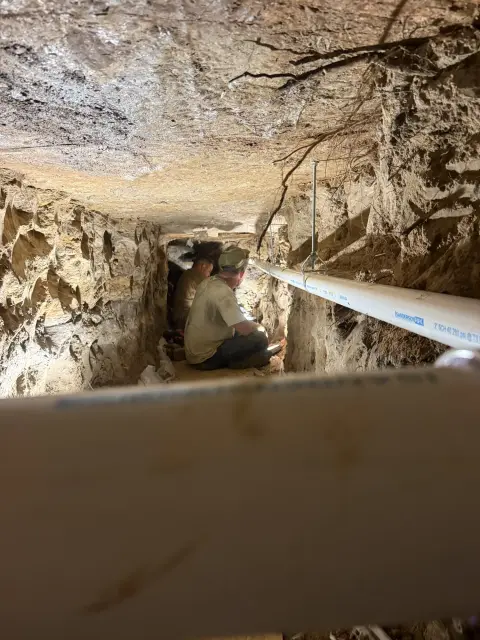
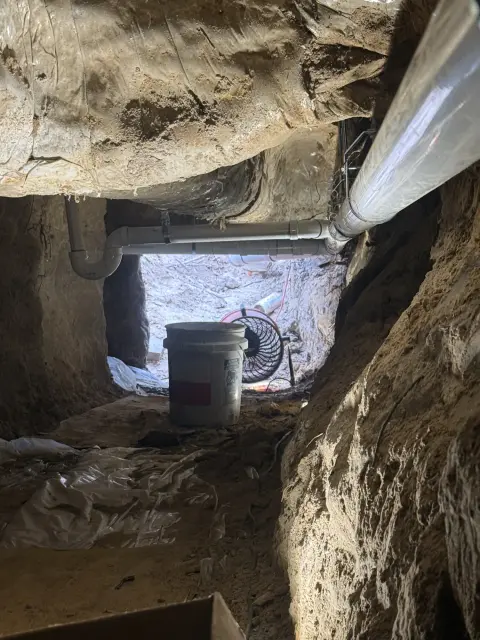
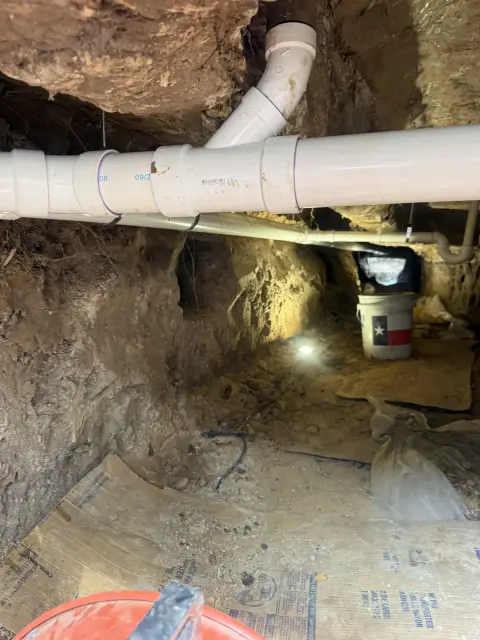
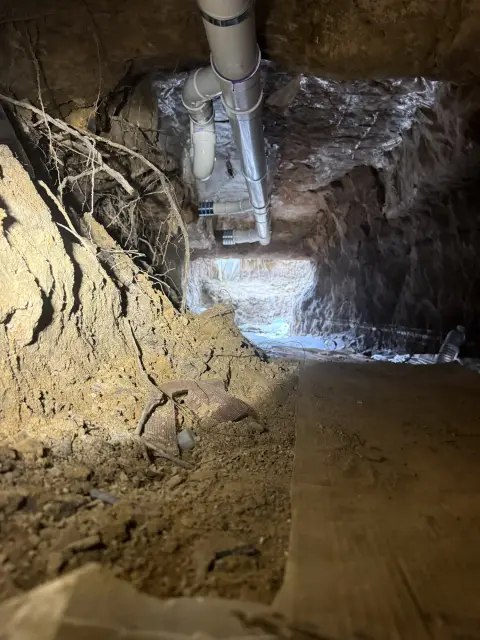
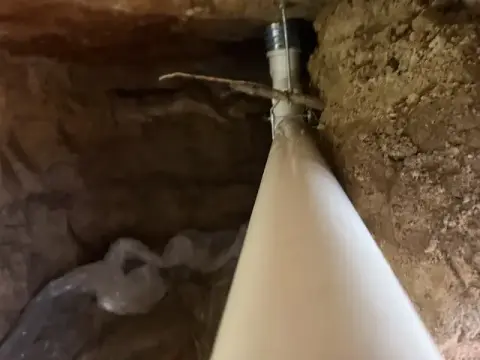
A tunnel starts outside the foundation, usually from a point in the yard close to where the pipe is believed to run. The crew digs down and then in, working horizontally under the footing and into the space beneath the slab, removing soil by hand as they go rather than with heavy equipment that has no room to operate in that void. In sandy or loose sections of Gulf Coast soil, the tunnel gets shored as it's dug, bracing the sides so the walls don't collapse in on the crew working inside it. The tunnel itself is sized for one person to move through and work with hand tools, no larger than it needs to be, because every extra foot of void is more soil that has to be replaced correctly when the job is done. Once the crew reaches the pipe, the repair itself happens in that confined space before anyone starts filling the tunnel back in.
Backfill and Compaction: The Part of the Job Nobody Sees
The digging gets the attention, but the backfill is what determines whether a Beaumont homeowner ends up with a repaired pipe or a foundation problem waiting a few years out. Soil that gets shoveled back into a tunnel loosely, without being placed in layers and compacted as it goes, settles over time. That settling doesn't happen the week after the job. It happens gradually, over the following seasons and years, as rain works its way down through loose fill and the ground under the slab slowly loses the density it had before anyone dug into it. A foundation that loses support in even one spot can crack or settle unevenly, and repairing that kind of damage costs far more than the original leak ever would have. Porter's backfills a tunnel in lifts, placing and compacting soil in stages rather than pushing it all back in at once, so the ground under a Beaumont slab ends up as dense and stable as it was before the tunnel was ever dug.
Tunneling Isn't Just for Slab Leaks
Most people hear tunneling and think of a single slab leak repair, but it's an access method, not a repair type, and Porter's uses it for more than one kind of job across Jefferson County. A sewer line running under a slab that's collapsed, bellied or root damaged can be reached and replaced by tunnel rather than cutting the yard and the floor both open from above. A full repipe on an older Beaumont home, the kind still running galvanized or copper from the Spindletop era, can sometimes be run through a tunnel instead of opening every room the old pipe passes under. Commercial buildings near the Port of Beaumont with a sewer line under a slab floor face that same choice, and for a business that can't afford to close for a torn up floor, tunneling is often worth the extra time. The logic stays the same across all three: reach the pipe without opening the floor above it.
When Tunneling Isn't the Right Call
Tunneling isn't automatically the better choice just because it protects the floor. It takes longer than breaking the slab, and on a job where the pipe sits shallow, close to the foundation's edge, or under a room with bare concrete already, tunneling adds time for a benefit that doesn't apply, there's no finished floor to protect. Tight yards with little room to open an exterior access point can rule it out too, along with landscaping, a driveway, or a structure built too close to the foundation. Porter's will recommend breaking the slab when that's genuinely the better option for a Beaumont home, rather than defaulting to a tunnel because it sounds like the gentler choice on paper.

Need Under-Slab Tunneling in Beaumont?
Get a free estimate. Call (409) 217-9371 or request a quote online.
Other Services in Beaumont, TX
Recent Under-Slab Tunneling in Beaumont
Explore Related Services
Under-Slab Tunneling FAQ — Beaumont
Is tunneling always better than breaking through my slab?
How big does a tunnel actually need to be?
What happens if the backfill under my house isn't compacted properly?
Can tunneling be used for a full repipe, not just a single leak?
Dwayne Porter, Owner
Porter's Plumbing Solutions · Est. 2022
Updated October 2026
Ready to Get Started?
Get a free, no-obligation estimate for your project.